Have you thought of having something that can store energy just like batteries, but are not batteries? You guess right! Ultracapacitors. This is also called supercapacitors. So in this article, we would used the two terms interchangeably. In this article we would consider the following:
- What are Ultracapacitors
- How does Ultracapacitors work
- Design of Ultracapacitors
- Ultracapacitor versus conventional capacitor
- Comparison between Batteries and Ultracapacitors
- Application of Ultracapacitors
Let’s start with the first one.
What are Ultracapacitors?
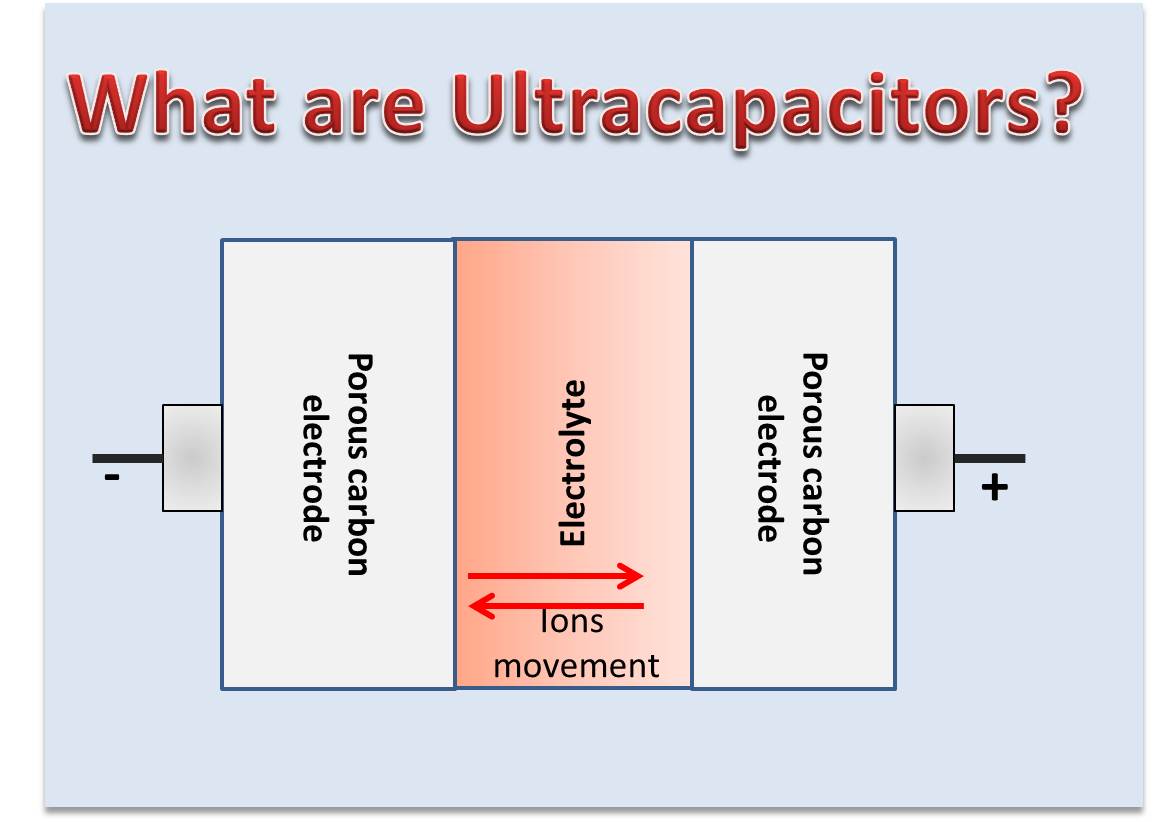
Sometime called Supercapacitors are devices that store electric energy just like batteries. But unlike batteries, ultracapacitors can store power for an extended period of time. Unlike batteries too, ultracapacitors does not have a lifetime, they can continue to work as long as they are always recharged. The structure of an ultracapacitor is given in Figure 1, showing the basic components
 |
| Figure 1: Basic Components of an Ultracapacitor |
How Does Ultracapacitors Work?
Remember that capacitors are electronic devices that store charges.So when you switch off your television set, the indicator light does not go off immediately, it stays for a few seconds after power is turned off. This is power stored in capacitors.
Supercapacitors work based on the same principle. I discuss design of ultracapacitors in the next section.
Design of Ultracapacitors
In line with the principle of my blog, I would keep this discussion simple and to the point.
The same basic components of a capacitors also forms the basic components of an ultracapacitor namely:
Two Electrodes with a material(dielectric) separating the two. The material in between is what makes the difference. For normal capacitors, the separating material. In untracapacitors, this materials is made up of double layer of different ion-permeable materials. When voltage is applied on both electrodes, they become polarized and ions move from on end to another, thus generating electricity. The effect generated is called double-layer effect.
Ultracapacitors vs Conventional Capacitors
While conventional capacitors could store powers for few seconds, supercapacitors are designed to retain power for several minutes or even hours. With respect to the design, the separating material in ultracapacitors is double layer as opposed to single layer in conventional capacitors. That is why ultracapacitors are sometimes called double-layer capacitors.
Comparison Between Batteries and Ultracapcitors
The question that logically arise is: “Could ultracapacitors replace batteries in future?”. Let’s answer that question by making a brief and simple comparison between batteries and ultracapacitors.
1. Batteries store charges for a longer time than ultracapacitors.
2. Ultracapacitors deliver a lower amount of voltage compared to batteries.
3. Ultracapacitors maintain much longer lifetime than batteries.
4. Ultracapacitors are said to have low energy density. This means that unlike batteries, they cannot be used as a continuous energy source.
5.
Applications of Ultracapacitors
Ultracapacitors are applied in various areas today including the following:
1.Home Electronic:: For many home and small electronics such as laptops, pcs, PDAs, portable media players, ultracapacitors is used to produce a UPS(uninterruptible power supply) effect allowing the device to continue functioning even when power goes out.
2. Wireless Electronic Tools: This could be screwdrivers, blowers, drilling machines etc. which may be used in areas where the cables from the mains could not easily be connected. Ultracapacitors can provide the needed power.
3. Electric Vehicles: This is the most notable area of application. Although, batteries may be used in electric vehicles, ultracapacitors are used to provide alternative or supplementary power for the vehicle’s auxiliary devices.
4. Transportation: In trams, metro trains, metro buses etc, ultracapacitors can be used to supply auxiliary power.
5. Field of Medicine: They can be applied in defibrillators in the treatment of certain heart diseases.
6. Street Lighting: Ultracapacitors could be used in street lighting to retain power in the event of a temporary power outage.
 by
by