 by
by Similar Posts
Now, since blockchain is based on the Internet, we can see it as a more powerful and secure subset of the Internet.
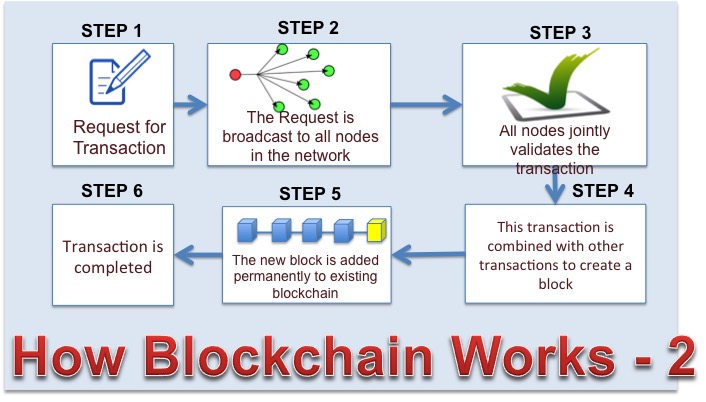 |
| Figure 1: How Blockchain Works – Part 2 |
1. Transaction is Requested
A transaction may be transfer of bitcoin to another account(user wallet), new user joining the system, buying/selling transaction etc. So in step one, a transaction is requested by a user which could be you or me.
2. Request is Broadcast
Since the database is a distributed database, all nodes in the network needs to get the transaction request (in centralized database, your a bank teller handles independent of other bankers/customers). Simply put, everyone in the network/blockchain gets the request.
3. All Nodes Confirms and Validates the Request
This is where the system supersedes conventional system in the aspect of security. Before the transaction is entered, all node has to confirm and verify it. Making sure its authentic. The distributed database system handles this. It takes “some time”, but it has to be done to ensure the integrity and consistency of the system.
4. A Block is Created (This process is called Mining)
When all nodes have reached a consensus that the transaction is legitimate and can be accepted, then a block can be created. A number of confirmed transactions is combined and recorded together as a block (a block is a combination of two or more individual transactions)
5. Block is Recorded
The recording is actually done in this step. In the previous step, a block is created by combining the transactions. In this step, this new block in recorded permanently to the chain.
6. Transaction is Completed
Here the transaction is marked as completed and relevant notifications are sent out.
1. Allows transactions to be carried out without the delays and bureaucratic nature of having a middle-entity such as banks
Don’t forget to read the following:


Good to know
[…] Blockchain Technology Explained-Part 2(Distributed Database […]
[…] Blockchain Technology Explained-Part 2(Distributed Database […]