 by
by Introduction to machine learning starts with a simple idea: systems that improve at a task by learning patterns from data, instead of being fully hand-coded for every case. Another useful definition: machine learning is the process of deducing unknown values from known values.
This guide covers what machine learning is, a short theory example, and the main types of machine learning problems — supervised, unsupervised, and reinforcement learning — including classification vs regression.
What Is Machine Learning?
Machine learning is a branch of artificial intelligence that gives a computer system the ability to progressively learn and improve performance on tasks without being explicitly programmed for every detail of those tasks.
In practice, you collect examples (data), choose a model, and train it so that it can make useful predictions or discover structure on new inputs it has not seen before.
The Theory Behind Machine Learning
Remember the second definition: determine unknown values given a set of known values.
Example: Class 5 students usually score between 70% and 100%. Class 3 students usually score between 40% and 60%. A new student scores 45%. Which class would you place them in?
Most people choose Class 3, because 45% falls in the Class 3 range. That intuition is classification: assign a new observation to a category using patterns learned from labeled examples.
A Simple Classification Example
Given a training dataset of N observations {xn} (n = 1, …, N) and corresponding target values {tn}, the goal of machine learning is to predict t for a new value of x.
The usual approach is to construct a function y(x). For a new input x, y(x) is the prediction for t. We also care about uncertainty — often written as p(t | x), the probability of t given x. That captures how confident the model is.
That is the core theory in plain language: make predictions about what is not yet known, using structure learned from what is known. For a deeper walkthrough of classification, see Classification in Machine Learning.
Types of Machine Learning Problems
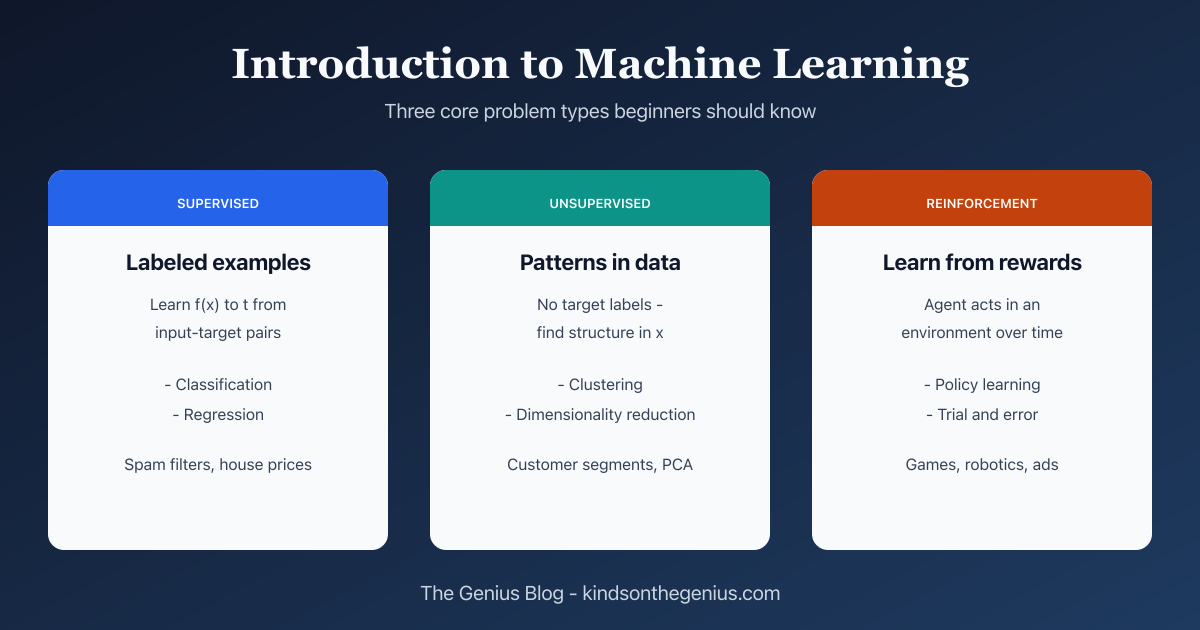
Machine learning problems are commonly grouped into supervised learning, unsupervised learning, and reinforcement learning. Related settings include semi-supervised learning and active learning.
Supervised Learning
In supervised learning, the training set includes input vectors {x} and corresponding target values. The task is to find a function f(x) such that f(x) ≈ t for new inputs.
Supervised problems are usually either classification or regression.
Classification: Targets come from a finite set of categories. The model assigns each input to one of those discrete classes (for example, spam vs not spam).
Regression: Targets are continuous values in real-valued space (for example, predicting a house price). For a practical regression walkthrough, see Machine Learning 101 — Basics of Logistic Regression and related regression tutorials on the blog.
Unsupervised Learning
Unsupervised learning looks for patterns or structure in the input data without target labels. Common goals include:
- Clustering — group similar examples (see What is K-Means in Clustering)
- Density estimation — model how data is distributed
- Dimensionality reduction — map high-dimensional data to fewer dimensions (for example 2D/3D) while keeping important structure
Reinforcement Learning
Reinforcement learning is a third major class of problem. An agent takes actions in an environment and receives rewards or penalties. Over time it learns a policy — which actions to take in which situations — to maximize expected reward.
Classic applications include game playing and robotics. Reinforcement learning is not the same as supervised or unsupervised learning, and it is not a subtype of semi-supervised learning.
Semi-Supervised and Active Learning
Semi-supervised learning uses a mix of labeled and unlabeled data when labels are expensive to obtain.
Active learning lets the model (or a training loop) choose which unlabeled examples should be labeled next, to improve performance with fewer labels.
Frequently Asked Questions
What is machine learning in simple terms?
Machine learning is a field of AI where systems improve at a task by learning patterns from data instead of being fully hand-coded for every case.
What are the main types of machine learning?
The three core types beginners should know are supervised learning, unsupervised learning, and reinforcement learning. Semi-supervised and active learning are important related settings.
What is the difference between classification and regression?
Classification predicts discrete labels or categories. Regression predicts continuous numeric values.
Is reinforcement learning supervised or unsupervised?
Neither. Reinforcement learning learns from rewards and penalties through interaction with an environment, not from a fixed labeled dataset alone.
Next Steps and Further Reading
You now have an overview of machine learning: definitions, the prediction framing, and the main problem types. Next, go deeper with these beginner tutorials:
- Basics of Neural Networks
- Basics of Perceptron in Neural Networks
- Classification in Machine Learning
- What is K-Means in Clustering
- Introduction to Support Vector Machines (SVM)
- All Machine Learning tutorials
Want structured ML training? Join Alkademy for instructor-led machine learning and data science classes with hands-on projects.


[…] will try to explain Likelihood Function in very clear and simple terms. Likelihood Function in Machine Learning and Data Science is the joint probability distribution(jpd) of the dataset given as a function of […]
Your blog is very unique and interesting about Machine Learning Training.
very nice and informative blog Machine Learning Training.
Thanks for the super Content and More Machine Learning Training Data Science Training Provides to me
Thanks for your detailed explanation. Sir continued extensions on linear regression using statsmodel and another video on sns plots can’t be found.
Thanks a lot Dr. Krishna!
Great Post, Really very happy to say,your post is very interesting to read.keep sharing.
Highly informative article. This site has lots of information and it is useful for us. Thanks for sharing your views.
Thanks for sharing nice information and nice article and very useful information…
Glad you like Machine Learning tutorial and it proves useful to you. We tried to explain each and every term related to Machine Learning Training
One of the best taught courses.The content is extremely interesting and useful.
Informative post. Concept has been explained very well.Looking forward for such informative posts
Really useful information. I learned some new points here.I wish you luck as you continue to follow that passion.
Nice!
Excellent post. Gained a lot of knowledge from it. Looking ahead for more of such interesting postings
thanks for sharing such valuable information with us. it’s hard to come by well-informed people in this particular topic, but you explained this really good..
Nice Blog. Thanks for the information. about the What is machine learning and when it used concepts.
I really enjoy studying on this website, it holds wonderful posts. Excellent Machine Learning blog you have got here… It’s difficult to find excellent writing like yours these days. I really appreciate individuals like you!
[…] 3. Reinforcement Learning: This is a more recent class of Machine Learning problem developed in 1998 and is concerned with finding the best action to take in a given situation to maximize the expected outcome. One application area is reinforcement learning is in Game Playing where the objective at each point is to take an action that increases the changes of wining. […]
Hi, Thanks for sharing nice articles…
This is an excellent course which helped me a lot .Thanks for sharing the content
Excellent post. Gained a lot of knowledge from it. Looking ahead for more of such interesting postings
Thanks for sharing the valuable information .this article makes it easier to understand the topics very clear. It helped me a lot
Glad it helped you!
Thanks for such a great work
Thanks for such a great work
Thank you for giving this excellent blog. Useful to the beginner’s
You seem to be very well-versed at talking about your ideas and opinions in a way that’s easy for other people to understand.
A very interesting article. It was nice to read this and I especially liked the author’s perspective. I think a lot of people who read this will really enjoy and appreciate what’s been written here.
Great job, i love this topic & especially the way you have explained it is really awsome. Thnaks for sharing this info..
thank you for shearing nice information
nice explanation and thank you for shearing
Thanks For Sharing Yor Information,Your Content Is Very HealpFull
thanks nice
Great Information about . Thanks for sharing
[…] Python 3.10+, basic Python functions, and Cursor installed. Helpful background: Introduction to Machine Learning and the Python tutorials […]